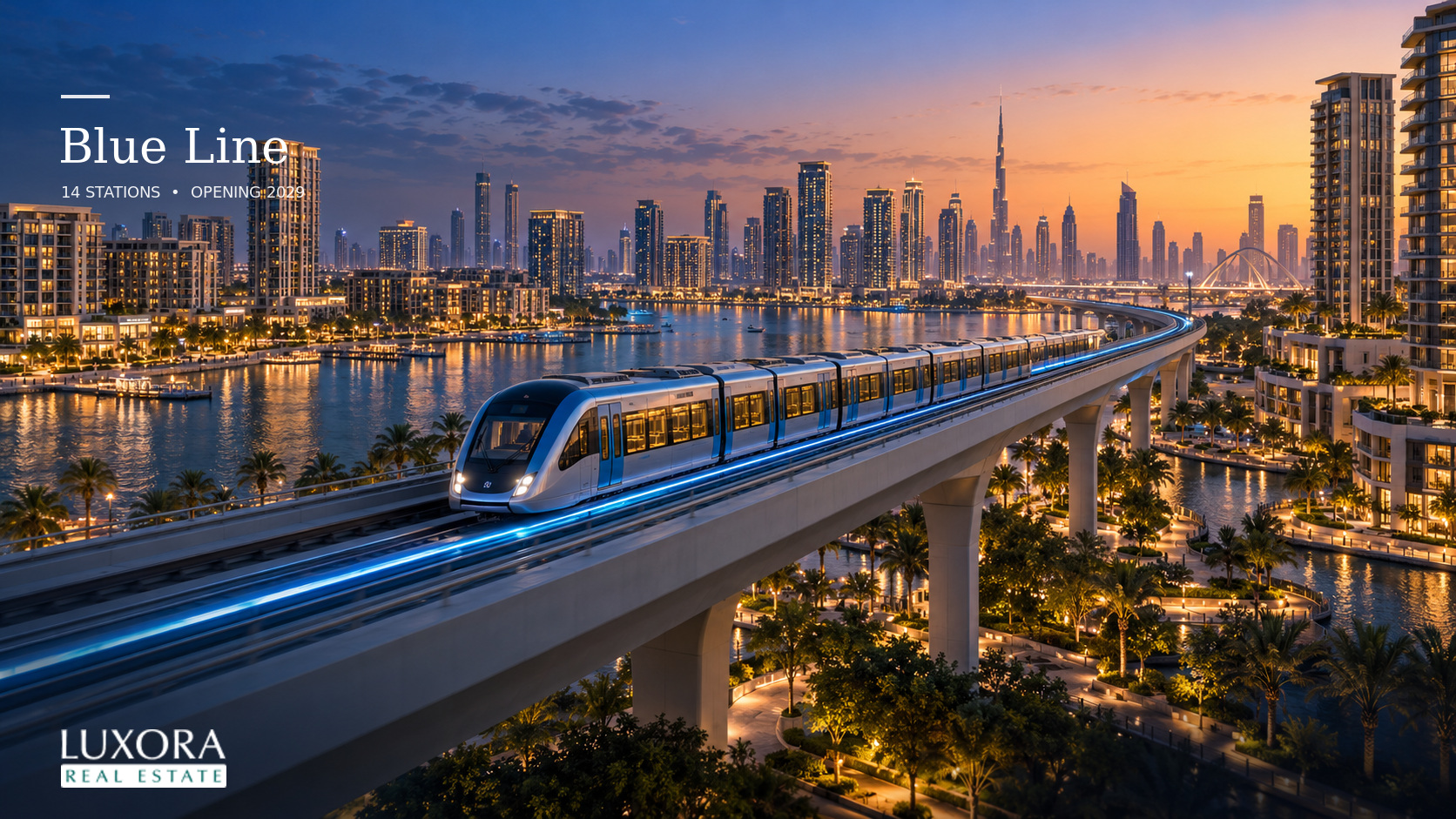
The Dubai Metro Blue Line is the biggest addition to Dubai's rail network since the Red and Green Lines opened, and it is now firmly under construction. In May 2026, His Highness Sheikh Mohammed bin Rashid Al Maktoum launched the tunnelling works, and the Roads and Transport Authority (RTA) has kept the opening date fixed at 9 September 2029, exactly 20 years after the first Dubai Metro journey.
For residents, the Blue Line means a direct rail link for communities such as Mirdif, Al Warqa, International City, Dubai Silicon Oasis and Dubai Creek Harbour, which today rely mostly on cars, buses and taxis. For buyers, landlords and investors, it raises a more practical question: which areas are likely to feel the benefit, and how much of that is already reflected in prices and rents?
This guide covers both. It explains the Blue Line route and map, every station area, the opening date and construction timeline, the cost and ridership forecasts, and what the available evidence says about property near new metro stations in Dubai.
Quick answer:
What it is: a new 30 km Dubai Metro line with 14 stations, run as two routes that meet at International City.
Opening date: 9 September 2029, according to the RTA and Dubai Media Office.
Interchanges: Creek Station (Green Line, Al Jaddaf), Centrepoint Station (Red Line, Al Rashidiya) and International City 1 (between the two Blue Line routes).
Areas served: Al Jaddaf, Dubai Festival City, Dubai Creek Harbour, Ras Al Khor, International City, Dubai Silicon Oasis, Dubai Academic City, Mirdif and Al Warqa.
Cost: more than AED 20.5 billion.
Progress: about 20% complete in May 2026, with the RTA targeting 30% by the end of 2026.
Dubai Metro Blue Line at a Glance
The table below brings together the key facts published by the RTA and the Government of Dubai Media Office, along with construction details reported by ENR in May 2026.
Item | Detail | Source |
|---|---|---|
Total length | 30 km | Dubai Media Office, May 2026 |
Underground section | 15.5 km | Dubai Media Office, May 2026 |
Above-ground section | 14.5 km | Dubai Media Office, May 2026 |
Stations | 14 (3 interchange, 7 elevated, 4 underground) | Dubai Media Office, May 2026 |
Routes | Route 1: 21 km, 10 stations. Route 2: 9 km, 4 stations | Dubai Media Office, May 2026 |
Investment | More than AED 20.5 billion | Dubai Media Office, May 2026 |
Opening date | 9 September 2029 | RTA and Dubai Media Office |
Expected daily riders | About 200,000 by 2030 and 320,000 by 2040 | RTA project page |
Population served | Nine areas with an estimated population of more than one million | RTA project page |
Estimated economic benefits | More than AED 56.5 billion by 2040 | RTA project page |
Expected traffic impact | About 20% less congestion on the corridors served | Dubai Media Office, May 2026 |
Depot | Al Ruwayyah 3 | Dubai Media Office, May 2026 |
Builder | MAPA, Limak and CRRC consortium, contract awarded December 2024 | ENR, May 2026 |
One point often causes confusion. Earlier announcements, including the RTA's project page, described the split as 9 elevated and 5 underground stations. The May 2026 Dubai Media Office announcement gives the more detailed and more recent breakdown of 3 interchange, 7 elevated and 4 underground stations. Both add up to 14, and the difference comes from how the interchange stations are counted.
Dubai Metro Blue Line Route and Map Explained
Unlike the Red Line, which runs as one long corridor along Sheikh Zayed Road, the Blue Line is shaped more like a "Y". It has two routes that join at an underground interchange in International City, and each route connects to a different existing metro line. This design lets trains run directly from Academic City to either the Green Line at Creek or the Red Line at Centrepoint.
Route 1: Creek to Dubai Academic City (21 km, 10 stations)
Route 1 is the longer of the two. According to the RTA's route description, it:
Starts at Creek Interchange Station in Al Jaddaf, where passengers can change to the Green Line.
Crosses Dubai Creek on a new 1.3 km metro bridge, the first metro bridge over the Creek.
Serves Dubai Festival City on the eastern bank.
Reaches Dubai Creek Harbour, home to the planned Emaar Properties Station.
Continues through the Ras Al Khor Industrial Area.
Arrives at International City 1, the underground interchange where Route 1 and Route 2 meet.
Carries on through International City 2 and 3.
Serves Dubai Silicon Oasis.
Ends in Dubai Academic City.
Route 2: Centrepoint to International City 1 (9 km, 4 stations)
Route 2 is shorter and links the Red Line to the new network. It:
Starts at Centrepoint Interchange Station in Al Rashidiya, the current eastern end of the Red Line.
Serves Mirdif.
Continues to Al Warqa.
Joins Route 1 at the International City 1 interchange.
How to Read the Dubai Metro Blue Line Map
If you look at the official Dubai Metro Blue Line map, it helps to think of three anchor points:
West end (Creek): the Green Line connection in Al Jaddaf, close to Bur Dubai, Healthcare City and the Creek.
North end (Centrepoint): the Red Line connection in Al Rashidiya, near Dubai International Airport.
South end (Academic City): the last stop, past Dubai Silicon Oasis.
International City 1 sits in the middle of these three points. Most of the underground section is around International City, Mirdif and Al Warqa, where the tunnel boring machine is working from a launch shaft at International City 1 in three directions. The sections near the Creek, Ras Al Khor, Dubai Silicon Oasis and Academic City are mostly elevated on viaducts.
The RTA says passengers in the areas served will be able to reach Dubai International Airport in about 20 minutes, using the Red Line connection at Centrepoint.
Dubai Metro Blue Line Stations: All 14 Explained
The RTA has described the Blue Line stations by the areas they will serve, and some final station names have not yet been published. The table below lists the station areas named by the RTA and Dubai Media Office, along with the type of community around each one. Route 1 has 10 stations in total, so some larger areas, such as International City and Academic City, may have more than one stop.
Station area | Route | Role | What is around it |
|---|---|---|---|
Creek (Al Jaddaf) | Route 1 | Interchange with Green Line | Al Jaddaf waterfront, Dubai Healthcare City side of the Creek |
Dubai Festival City | Route 1 | Station | Al-Futtaim's waterfront community with homes, retail and offices |
Dubai Creek Harbour (Emaar Properties Station) | Route 1 | Station | Emaar's master community, mostly high-rise apartments |
Ras Al Khor Industrial Area | Route 1 | Station | Industrial and commercial district |
International City 1 | Routes 1 and 2 | Underground interchange | Large, mostly apartment-based community |
International City 2 | Route 1 | Station | Residential area, including Nakheel's Warsan Village |
International City 3 | Route 1 | Station | Residential and commercial area |
Dubai Silicon Oasis | Route 1 | Station | Technology free zone and residential community |
Dubai Academic City | Route 1 | End of line | Universities and student and staff housing |
Centrepoint (Al Rashidiya) | Route 2 | Interchange with Red Line | Red Line terminus near Dubai International Airport |
Mirdif | Route 2 | Station | Established villa community, near City Centre Mirdif |
Al Warqa | Route 2 | Station | Residential villa area, near Dubai Safari Park |
The Three Interchange Stations
The three interchanges are what make the Blue Line useful for daily commuting rather than just local trips:
Creek Station: connects to the Green Line, which serves Deira, Bur Dubai, Dubai Healthcare City and Al Jaddaf.
Centrepoint Station: connects to the Red Line, which runs past the airport and along Sheikh Zayed Road to Downtown Dubai, Business Bay, Dubai Marina and beyond.
International City 1: connects the two Blue Line routes. It will be the largest underground interchange on the network, covering more than 44,000 square metres, with capacity for around 350,000 riders a day, according to Dubai Media Office.
In practice, this means a resident of Dubai Silicon Oasis could take the Blue Line to International City 1 and continue either towards the Creek or towards Centrepoint for the Red Line, depending on where they are heading.
Emaar Properties Station at Dubai Creek Harbour
The best-known station on the line is the Emaar Properties Station in Dubai Creek Harbour. Designed by architecture firm Skidmore, Owings & Merrill (SOM), it is planned to rise 74 metres and cover about 11,000 square metres. Dubai Media Office describes it as the world's tallest metro station.
The station is designed for up to 160,000 riders a day, with daily use expected to pass 70,000 by 2040. It will serve an estimated 40,000 residents in Dubai Creek Harbour, according to the same announcement.
Station Design Themes
In May 2026, Sheikh Mohammed also reviewed the interior design concepts for the new stations. Apart from the Emaar Properties Station, which follows a luxury theme with natural textures and warm tones, the stations are grouped into four themes:
Theme | Number of stations | Design idea |
|---|---|---|
Air | 3 | Open spaces and light |
Water | 2 | Flowing forms and calm colours |
Earth | 4 | Earthy tones and a sense of stability |
Fire | 2 | Vibrant colour gradations |
Dubai Metro Blue Line Opening Date and Timeline
The Dubai Metro Blue Line opening date is 9 September 2029. The date has been repeated in every major RTA and Dubai Media Office update since the project was approved, and it matches the date the Red Line opened in 2009.
Here is how the project has moved from approval to construction:
Date | Milestone |
|---|---|
November 2023 | Sheikh Mohammed approves the Blue Line route |
December 2024 | Design and build contract awarded to the MAPA, Limak and CRRC consortium |
June 2025 | Foundation stone laid and main construction begins |
September to November 2025 | First traffic diversions, including at Centrepoint and the International City 1 entrance from Ras Al Khor Road |
3 May 2026 | Tunnelling works launched with the "Al Wugeisha" tunnel boring machine; project about 20% complete |
July 2026 | RTA announces completion of the first phase of tunnelling works |
End of 2026 (target) | About 30% of the project complete |
9 September 2029 | Planned opening |
Construction Progress in 2026
The pace of work has picked up noticeably this year. When tunnelling started in May 2026, Dubai Media Office reported that:
More than 10,000 workers and over 500 engineers and specialists were working on the project.
More than 13 million work hours had been completed without a lost-time injury.
The tunnel boring machine, named Al Wugeisha after the basket used by pearl divers, is 163 metres long, weighs more than 2,000 tonnes and advances 13 to 17 metres a day.
A precast plant at International City produces 12 tunnel rings a day, and a separate factory produces 10 to 12 viaduct segments a day.
Piers for the 1.3 km Creek bridge were under construction.
In July 2026, The National reported that the RTA had completed the first phase of tunnelling in about two months. ENR, which covered the launch, reported that three earth pressure balance tunnelling machines are being used, chosen because the ground along the route includes marine sands, sabkha and a high water table.
Could the Opening Date Slip?
Large rail projects can run late, and the Blue Line has a long history. A line with the same name was first proposed in the 2000s, then shelved after the 2008 financial crisis. The current project is a new design approved in 2023.
So far, though, the official milestones have been met. The RTA reported 10% completion around five months after work began, 20% by May 2026, and is targeting 30% by the end of 2026. Dubai also has a track record of opening rail lines on fixed dates, including the original Red Line on 9 September 2009. Anyone making a property decision based on the Blue Line should still treat 2029 as the target, not a guarantee, and avoid paying a premium today that only makes sense if the line opens exactly on time.
Cost, Contractors and Who Is Building the Blue Line
The total investment is more than AED 20.5 billion, which ENR reported as about USD 5.6 billion. When the route was first approved in November 2023, the cost was given as AED 18 billion, so the figure rose once the contract was awarded and the design was finalised.
According to ENR's May 2026 report:
The design and build contract was awarded in December 2024 to a consortium of Turkish contractors MAPA and Limak with China's CRRC.
MAPA and Limak are handling the civil works, while CRRC is supplying the rail systems and 28 driverless trains.
A joint venture of AtkinsRéalis and Parsons is acting as engineer.
The Al Ruwayyah 3 depot is designed to hold 60 trains.
The RTA's own estimate is that the Blue Line will deliver more than AED 56.5 billion in economic benefits by 2040, through time savings, lower fuel use and fewer road accidents.
Ridership, Travel Times and What the Line Will Change Day to Day
The RTA expects around 200,000 people to use the Blue Line every day by 2030, rising to about 320,000 by 2040. For context, the existing Dubai Metro carried 295 million passengers in 2025, a 7% increase on 2024, and averages around one million riders a day, according to Dubai Media Office.
For people living along the route, the practical changes are likely to be:
Faster airport access: the RTA says areas served will be about 20 minutes from Dubai International Airport.
Shorter cross-city trips: Khaleej Times reported RTA estimates of 10 to 25 minutes between destinations on the line.
Less driving: the RTA expects congestion on the corridors served to fall by about 20%.
A real alternative to the car for students in Academic City, workers in Dubai Silicon Oasis and Ras Al Khor, and families in Mirdif and Al Warqa.
The RTA has not yet published Blue Line fares or operating hours. It is reasonable to expect the line to be integrated into the existing nol card system, but exact fares should be checked with the RTA closer to opening.
Blue Line Traffic Diversions: What Residents Should Expect Until 2029
Construction brings short-term disruption. By November 2025, the RTA had already put 11 traffic diversions in place, according to Khaleej Times, and said more were planned. Two examples:
In September 2025, the entrance to the Centrepoint multi-storey car park from Airport Road was closed.
On 22 October 2025, the entrance from Ras Al Khor Road into International City 1 was closed as part of the second construction stage.
The RTA has also held community meetings in affected areas, starting with Mirdif and Al Warqa in October 2025. If you are renting or buying in a Blue Line community, it is worth checking which roads near the building are affected and for how long, especially if you will be living next to a station site or viaduct during construction.
How the Blue Line Fits Into Dubai's Wider Metro Network
The Blue Line is one part of a larger expansion of public transport under the Dubai 2040 Urban Master Plan and the "20-minute city" concept, which aims to put daily needs within 20 minutes of most residents.
Line | Status | Key facts |
|---|---|---|
Red Line | Operating since 2009 | Centrepoint to Expo City Dubai and Life Pharmacy (UAE Exchange), including the Route 2020 branch |
Green Line | Operating since 2011 | Serves Deira, Bur Dubai and Al Jaddaf; links to the Blue Line at Creek |
Blue Line | Under construction, opening 9 September 2029 | 30 km, 14 stations, AED 20.5 billion |
Gold Line | Approved April 2026, opening planned 9 September 2032 | 42 km, 18 stations, fully underground, AED 34 billion |
Once the Blue Line opens, the Dubai Metro and tram network is expected to total 131 km, with 78 stations and 168 trains, according to The National. The Gold Line, approved in April 2026, will run from Al Ghubaiba through Business Bay, Meydan and Al Barsha South to Jumeirah Village Circle and Jumeirah Golf Estates. Gulf Business reported that it will take the metro network to 162 km and 85 stations.
This matters for property because it changes which areas are "metro-connected". Until now, most metro-linked communities sat along Sheikh Zayed Road, Deira and Bur Dubai. The Blue Line brings the east of the city onto the map, and the Gold Line will do the same for the inner south-west, including JVC.
Areas Where Property Could Benefit From the Blue Line
The RTA itself expects land and property values near Blue Line stations to rise by up to 25%. That is an official projection, not a guarantee, and it does not apply equally to every building in every area. How much a community benefits will depend on how close homes are to a station, what the area lacks today, how much new supply is coming, and how much of the expected gain is already priced in.
Here is a look at each area, with the latest available price data where a reliable source exists.
Area | Main property type | Latest price indicator | Source |
|---|---|---|---|
Dubai Creek Harbour | Apartments | Median AED 2,537 per sq ft (12 months to July 2026) | dataHabibi analysis of DLD transactions |
Dubai Silicon Oasis | Apartments, some townhouses and villas | Median AED 1,278 per sq ft; median sale AED 905,000 (12 months to July 2026) | dataHabibi analysis of DLD transactions |
International City | Apartments | Median AED 959 per sq ft; median sale AED 565,000 (12 months to July 2026) | dataHabibi analysis of DLD transactions |
Dubai overall | All types | Average AED 1,916 per sq ft (January to early June 2026) | Engel & Völkers, using Property Monitor and DLD data |
Reliable, recent per-area price data was not available from a single published source for Mirdif, Al Warqa, Dubai Festival City, Al Jaddaf, Academic City and Ras Al Khor, so those areas are described without price figures below. Luxora's agents can provide current transaction comparisons for any specific building.
Dubai Creek Harbour
Dubai Creek Harbour is the premium end of the Blue Line. It already trades well above the Dubai average, and it will have the line's signature station. The main benefit here is convenience and connectivity rather than a step change in value, because buyers already pay for the waterfront, the Emaar brand and views of Downtown.
Industry commentators quoted by Gulf News in 2025 saw Creek Harbour and Festival City as early beneficiaries because they are backed by master plans and close to the interchange stations. Buyers should keep in mind that Creek Harbour also has a large pipeline of new towers, which will compete with existing homes for tenants and resale buyers.
Dubai Festival City
Dubai Festival City is a mixed community on the Creek with villas, apartments, offices and Festival City Mall. Its current transport options are mainly road based. A station on the Blue Line, combined with the short ride to the Green Line interchange at Creek, should make it more practical for residents who work in Bur Dubai, Healthcare City or along the Red Line.
Al Jaddaf
Al Jaddaf already has a Green Line station, so the Blue Line will turn it into an interchange point rather than a newly connected area. That can still matter for demand, because Creek Station will become one of the main transfer points between the east of the city and the older centre.
International City
International City is one of Dubai's most affordable apartment communities, with a median sale price of about AED 565,000 over the 12 months to July 2026. It will get the line's biggest station, the underground interchange at International City 1, plus further stops in International City 2 and 3.
Because the area is mostly occupied by tenants who rely on buses and shared transport, a direct metro link could have a noticeable effect on rental demand. Gulf News sources described International City as a major gainer. The same affordability also means there is a lot of stock, so rent growth will depend on how quickly new supply arrives nearby, including projects such as Warsan Village.
Dubai Silicon Oasis
Dubai Silicon Oasis (DSO) has often been named as one of the clearest winners from the Blue Line. It combines a technology free zone with a residential community, and it has historically been popular with investors for rental yield. Gulf News reported in June 2025 that DSO apartment prices had risen by 80% or more between the end of 2022 and 2024, so some of the expected metro effect may already be reflected in prices.
The median price of about AED 1,278 per sq ft in the 12 months to July 2026 is still well below the Dubai average, which is part of DSO's appeal for buyers who want metro access without paying central prices.
Dubai Academic City
Academic City is the last stop on Route 1 and is home to a cluster of universities. The Blue Line should make the area far easier to reach for students and staff, many of whom do not drive. That could support demand for studios and smaller apartments built for this market.
Academic City showed the strongest rent increase of any Blue Line area in the betterhomes figures reported by Khaleej Times in June 2025. Studio rents rose from about AED 42,000 to AED 60,000 a year between November 2023 and mid-2025, a rise of 43%.
Mirdif
Mirdif is an established, family-oriented villa community near City Centre Mirdif and close to the airport. Mirdif already has a strong base of long-term residents, so the Blue Line is more likely to support demand and resale appeal than to transform the area. Villas within walking distance of the new station may become more attractive to families with older children and working adults who want an alternative to driving.
Al Warqa
Al Warqa is mainly a villa area south of Mirdif, near Dubai Safari Park. It has had limited public transport until now, so a station here is a bigger change in daily life than it is for areas that already have options. Sources quoted by Gulf News expected renewed interest in both Mirdif and Al Warqa as the line progresses.
Ras Al Khor
Ras Al Khor's station will mainly serve the industrial and commercial area. Over the long term, rail access could support redevelopment and changes in land use, a point raised by Springfield Properties' Farooq Syed in Gulf News. For residential buyers, it is more of a future story than an immediate one.
What the Evidence Says About Metro Lines and Property Values in Dubai
Projections about the Blue Line are useful, but the strongest guide is what happened when the Red and Green Lines opened.
Lessons From the Red and Green Lines
Betterhomes, using Property Monitor and its own data, told Khaleej Times in June 2025 that after the Red Line opened in 2009:
Sale prices for homes within a 15-minute walk of a station rose by more than 25%.
Homes within a 5 to 10-minute walk saw increases of about 40%.
Rents within a 15-minute radius rose by about 8%, and by about 14% within a 5 to 10-minute walk.
The pattern is clear: the closer a home is to a station, the stronger the effect. The benefit falls away quickly once a walk becomes too long, especially in Dubai's summer heat.
Rents Have Moved First
On the Blue Line, rents started rising long before any trains run. According to the same betterhomes data, average rents across the nine Blue Line districts rose by about 23% between the line's approval in November 2023 and mid-2025:
Area | Rent change, November 2023 to mid-2025 |
|---|---|
Academic City | Up 43% |
Dubai Creek Harbour | Up 30% |
Al Warqa and Dubai Silicon Oasis | Up 28% |
International City 1 and 2 | Up 22% |
Ras Al Khor Industrial Area | Up 21% |
Mirdif and Dubai Festival City | Up 15% |
Part of this rise reflects the wider Dubai rental market, which was strong across the city in 2024 and early 2025, so not all of it can be credited to the metro. The rental market has also cooled in 2026. The National reported in June 2026 that rising supply was giving tenants more negotiating power, so the next few years are unlikely to repeat the same pace of growth.
Why "Near the Metro" Needs a Careful Definition
When a listing says "near the Blue Line", it is worth checking what that really means:
Walking distance: the historical gains were concentrated within roughly a 5 to 15-minute walk. A building 2 km away with no direct footpath will see much less benefit.
Station access: check where the station entrances are likely to be and whether there is a safe pedestrian route or footbridge.
Noise and views: homes directly facing an elevated viaduct may gain access but lose some privacy or views.
Construction period: homes next to station sites will live with works and diversions until 2029.
Buying or Renting Near the Blue Line in Today's Market
The Blue Line is being built against a changing market. Dubai residential sales fell 38% by volume and 47% by value in Q3 2026 compared with a very strong Q3 2025, according to Cavendish Maxwell figures reported by The National. S&P Global Ratings has also said it expects Dubai's residential stock to grow by about 20% over the next two years, which could weigh on prices, especially for apartments.
That does not cancel out the benefit of a new metro line. It does mean buyers have more room to negotiate, and that location quality will matter more than in a rising market. Homes with genuine walking access to a station are more likely to hold demand when supply increases than homes that only share the same community name.
For End Users
Focus on daily use: how far you would walk to the station and where you need to travel.
Consider the construction period if you plan to move in before 2029.
Compare ready homes near station sites with off-plan homes due around the opening date. Browse current apartments for sale in Dubai and villas for sale in Dubai to compare options.
Use the Luxora mortgage calculator to check monthly payments before you commit.
For Investors
Look at rent and yield, not just expected growth. Areas like DSO and International City are mainly rental markets.
Check the supply pipeline in each area. New towers near a station can absorb much of the extra demand.
Avoid paying a "metro premium" on top of prices that already reflect the line. Compare recent transactions in buildings close to and further from the station.
Consider your holding period. Construction disruption and new supply can hold prices back before 2029, so the case for buying usually rests on owning beyond the opening date.
Explore new launches through Luxora's projects and our market insights.
For Tenants
If you rent in a Blue Line area now, you may face some construction disruption, but you could benefit from stronger transport links before your next move.
Check your rights on renewals. The RERA rent increase calculator guide explains how much a landlord can raise the rent.
Make sure your contract is registered. See our guides to Ejari registration and the tenancy contract in Dubai.
Compare options on Luxora's apartments for rent in Dubai page.
A Practical Checklist Before Buying Near a Blue Line Station
Confirm the nearest station location on the latest RTA map, not just the community name.
Measure the walking route from the building to the likely station entrance.
Check whether the station is elevated or underground, and whether the viaduct passes close to the unit.
Review recent DLD transactions in the building and in nearby buildings further from the station.
Look at the area's new supply pipeline for 2026 to 2029.
Estimate rent and yield using today's rents, not projected ones.
Plan for construction disruption if you will live there before 2029.
Build a margin of safety in case the opening date moves.
Get advice from an agent who knows the area. You can speak to Luxora's agents for building-level guidance.
Final Thoughts
The Dubai Metro Blue Line is no longer a plan on paper. With a fixed opening date of 9 September 2029, tunnelling under way and around a fifth of the work done by May 2026, it is on track to bring direct rail access to communities in the east of Dubai that have relied on roads for years.
For property, the line is a long-term positive for areas such as Dubai Silicon Oasis, International City, Academic City, Mirdif, Al Warqa, Dubai Festival City and Dubai Creek Harbour. The biggest gains are likely to go to homes within a short walk of a station, and some of the effect is already reflected in rents and prices. In a market where supply is rising, the best opportunities will come from careful building selection rather than buying anything with "Blue Line" in the listing.
If you are considering a home or investment near the Blue Line, Luxora Real Estate can help you compare buildings, check recent transactions and find the right property for your plans. Explore properties for sale in Dubai, browse communities in Dubai, or contact our team for tailored advice.