Jebel Ali Village is one of the oldest residential addresses in Dubai, and in 2026 it became one of the newest. The original village of low bungalows, built in the late 1970s for port staff, was cleared in 2022. In its place, Nakheel has built a gated, low-density community of villas and townhouses, and on 17 August 2026 the developer announced that it had begun handing over 892 homes to owners.
In short: Jebel Ali Village is an 80-hectare Nakheel community next to Sheikh Zayed Road, close to Ibn Battuta Mall and Discovery Gardens Metro Station, planned for about 5,500 residents. It offers four- and five-bedroom villas and three- and four-bedroom townhouses, with handovers under way since August 2026 and several community facilities still to come.
This guide explains how the village got here, what the master plan includes, the home types Nakheel has published, how the location connects to the rest of Dubai, and what owners and tenants should expect in the first year after handover. It closes with a comparison against nearby communities and a practical checklist.
Key takeaways
Nakheel, now part of Dubai Holding Real Estate, started handing over 892 homes at Jebel Ali Village in August 2026.
The community covers 80 hectares and is planned for roughly 5,500 residents.
Villas launched in November 2021 with four and five bedrooms; Nakheel quoted average plots of about 6,900 sq ft and 7,600 sq ft respectively.
Townhouses followed in March 2022 with three and four bedrooms and sizes of 2,882 to 3,386 sq ft.
Parks, cycling routes, play areas, a pond and cluster pools are open; a community centre with retail, a clubhouse, gym, padel courts and event lawns are still planned.
The original village of around 290 homes dated from 1977 and was demolished in 2022 after tenants received 12-month notices.
Because the community is newly handed over, expect a settling-in period: snagging, utility set-up, landscaping and amenities still being finished, and an evolving rental market.
Jebel Ali Village at a glance
Item | Detail |
|---|---|
Master developer | Nakheel, a member of Dubai Holding Real Estate |
Community size | 80 hectares |
Homes being handed over | 892 villas and townhouses (handover began August 2026) |
Expected population | About 5,500 residents |
Villas | Four and five bedrooms; average plots about 6,900 sq ft (641 sq m) and 7,600 sq ft (706 sq m) |
Townhouses | Three and four bedrooms; 2,882 to 3,386 sq ft |
Layout | Gated, low-density, organised in residential clusters, each with its own pool |
Main road | Next to Sheikh Zayed Road |
Nearest landmarks | Ibn Battuta Mall, Discovery Gardens Metro Station, Jebel Ali Recreation Club |
A short history of Jebel Ali Village
The original village (1977 to 2021)
Jebel Ali Village was built in 1977 as part of Sheikh Rashid bin Saeed Al Maktoum's plan to develop Jebel Ali as a self-contained industrial zone with its own port and township. Its first residents were largely British and Dutch staff working on the nearby Jebel Ali Port, and over time the village attracted families of many other nationalities.
The layout was designed by the engineering firm Sir William Halcrow and Partners as a small garden city, with single-storey homes set among trees and open space. Because it was a long way from central Dubai at the time, the village became unusually self-sufficient. A school grew up to serve port families; it later became Jebel Ali School, which ran from the village for decades before moving to a new campus in Akoya by Damac in 2018. The Jebel Ali Recreation Club became the village's social hub.
Stalled plans, then a full rebuild
Redevelopment was first proposed well before the current scheme. Plans from around 2008 included new retail and community facilities and a larger central park, but the global financial crisis put them on hold, and in 2013 Nakheel said it would renovate the existing villas instead.
That changed in November 2021, when Nakheel announced it would rebuild the village as an upscale gated community. Residents of the roughly 290 homes were given 12 months to move out. Demolition was reported as under way by late June 2022, with some residents unhappy that work began while tenancies were still running.
Launch, construction and handover
The first phase of four- and five-bedroom villas went on sale on 7 November 2021. Townhouses were added in March 2022. In March 2024, Dubai's Ruler mandated the incorporation of Nakheel into Dubai Holding, which is why the 2026 handover announcement carries the Dubai Holding Real Estate name alongside Nakheel. Handover of 892 homes began in August 2026, after residential construction and core infrastructure were completed.
Year | Milestone |
|---|---|
1977 | Original village built for Jebel Ali Port staff |
c. 2008 | Earlier redevelopment plan announced, later shelved after the financial crisis |
2013 | Nakheel opts to renovate existing villas |
2018 | Jebel Ali School moves out of the village to Akoya by Damac |
Nov 2021 | New villa community announced; tenants given 12-month notices; first villa phase goes on sale |
Mar 2022 | Townhouses launched |
Mid-2022 | Demolition of the original homes |
Aug 2026 | Handover of 892 homes begins |
The village's garden-city layout is often cited as a model for The Gardens and Emirates Hills, and Nakheel has framed the new community as building on that heritage.
The Jebel Ali Village master plan
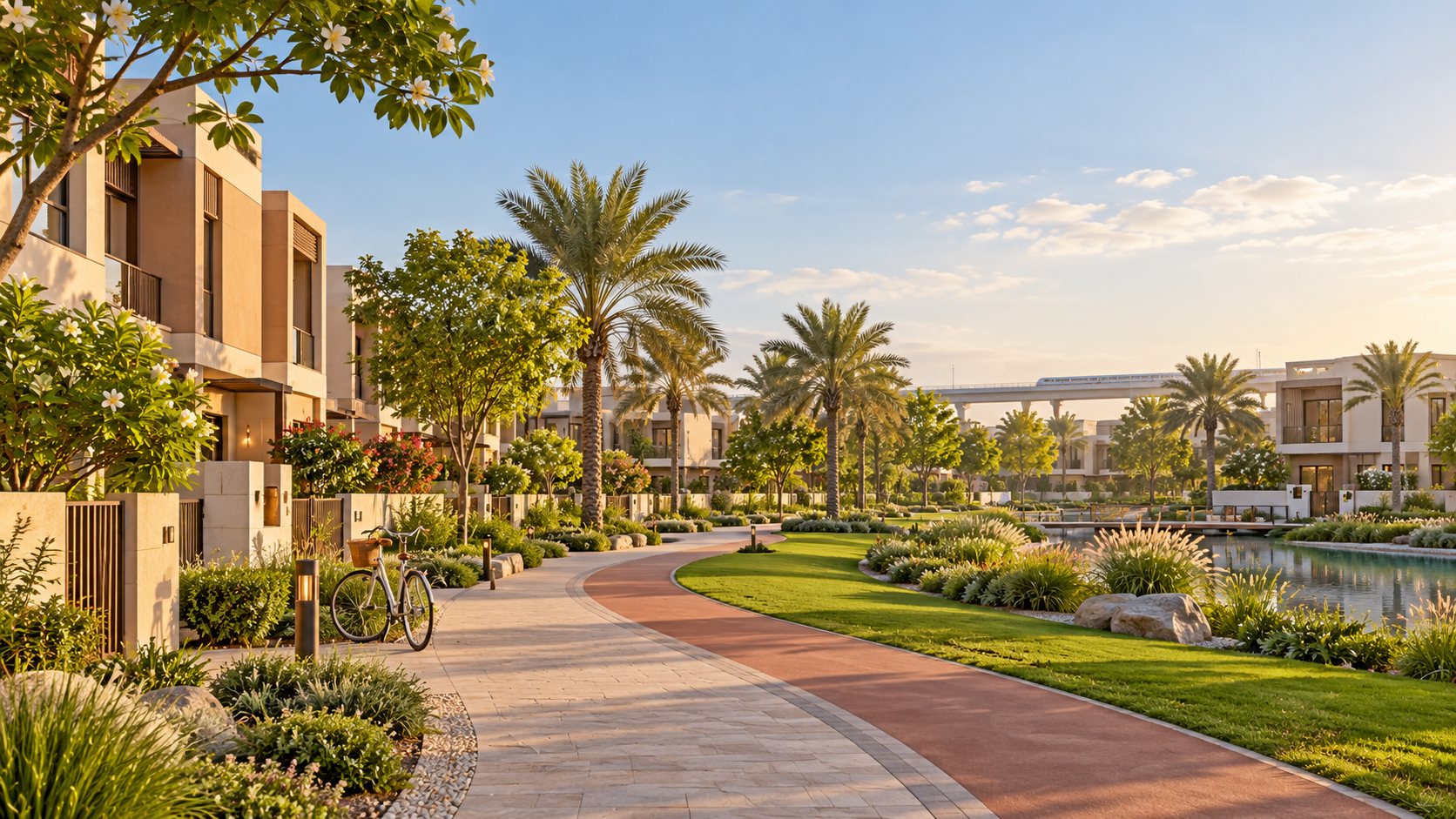
The Jebel Ali Village master plan covers 80 hectares and is organised as a gated, hillside community of residential clusters set among parks and green corridors. At launch, Nakheel described three clusters, each with villas, swimming pools, parks and sports facilities. Townhouses were added to the mix in 2022.
The design priorities are clear from the developer's material: low density, pedestrian-friendly streets, connected green spaces and outdoor recreation. With 892 homes on 80 hectares, the community is considerably less dense than the apartment districts on its northern side.
What is open now and what is still coming
At the start of handovers, Nakheel listed the following as available to residents:
Landscaped parks and open spaces
Walking and cycling routes
Sports facilities
Children's play areas
A community pond
Swimming pools within each residential cluster
Still planned as part of ongoing development:
A community centre with retail
A clubhouse
A gym
Padel courts
Event lawns
Earlier launch material also mentioned a mosque, jogging tracks, bike trails, a community vegetable farm, a five-a-side football pitch and a basketball court. Nakheel's current project page lists sports courts, green trails, a cycling track, off-road mountain bike trails, a duck pond and the Jebel Ali Recreation Club. Nakheel has not published opening dates for the planned facilities, so anyone moving in during the first year should expect parts of the community to still be under construction.
The Jebel Ali Recreation Club
The Recreation Club is one of the few pieces of the old village that carried through. Nakheel said in 2021 that it would remain open throughout the redevelopment, offering dining, fitness and leisure, with further upgrades planned. For new residents, it gives the community an established social venue from day one, which many new communities lack.
Villas and townhouses in Jebel Ali Village
Nakheel has released two product types: standalone villas and townhouses. It has not published the split of the 892 homes between the two, nor a full list of floor plans, so the details below are limited to what the developer announced at each launch.
Villas
The villas launched first, in November 2021, with four- and five-bedroom layouts. Nakheel quoted an average plot of about 6,900 sq ft for a four-bedroom villa and 7,600 sq ft for a five-bedroom villa; The National later expressed these as 641 sq m and 706 sq m. Features listed at launch included:
Single-row positioning and open-plan layouts
Gardens with space for a private pool
Floor-to-ceiling windows
En-suite bathrooms in every bedroom, a maid's room and a storage room
A driver's room in some villas
A three-car private garage with a remote-control door and an electric car charger
An option on some villas to extend upward with a penthouse floor, including a terrace, living room, bathroom and lift
"Single row" means the villas are not backed directly onto other homes, which usually gives more privacy and light. The pool space and penthouse option mean two villas of the same bedroom count can differ a lot in practice, so buyers looking at a Jebel Ali Village villa for sale should ask exactly what the seller has added.
Townhouses
Jebel Ali Village townhouses were launched in March 2022 with three and four bedrooms and sizes of 2,882 to 3,386 sq ft (about 268 to 315 sq m). Each was described with:
A ground-floor guest suite
A terrace
En-suite bathrooms and built-in wardrobes
A maid's room and laundry room
A garage for two cars
A choice of light or dark interior colour schemes
The Nakheel handover release also mentions duplex homes with double-height living areas in selected units. The ground-floor guest suite is a useful feature for families with older parents or regular visitors, since it avoids stairs.
Feature | Villas | Townhouses |
|---|---|---|
Launched | November 2021 | March 2022 |
Bedrooms | 4 and 5 | 3 and 4 |
Published size | Average plot ~6,900 sq ft (4BR) and ~7,600 sq ft (5BR) | 2,882 to 3,386 sq ft |
Parking | Three-car private garage with EV charger | Two-car garage |
Staff accommodation | Maid's room; driver's room in some units | Maid's room |
Notable extras | Pool-ready garden; optional penthouse floor on some villas | Ground-floor guest suite; terrace |
Sources: Nakheel and Dubai Media Office launch releases. Note the villa figures are plot sizes and the townhouse figures are unit sizes, so they are not directly comparable.
Prices and payment plans
Nakheel has not published current prices for Jebel Ali Village, and launch pricing was not included in its official releases. With handovers only just under way, the resale and rental market is still forming. For a sense of the wider market, Luxora's Dubai property market report for Q3 2026 covers recent price and supply trends. For specific homes, compare live listings and ask for recent Dubai Land Department transaction data on the exact cluster and plot type.
Location and connectivity
Jebel Ali Village sits next to Sheikh Zayed Road in south-west Dubai. To its north are The Gardens and Discovery Gardens, Al Furjan is to the east, and the Jebel Ali industrial area lies to the south. Ibn Battuta Mall and Ibn Battuta Metro Station are to the north-west.
Roads
Sheikh Zayed Road is the main artery, linking the community north towards Dubai Marina, Al Sufouh and Downtown Dubai, and south towards Abu Dhabi. Nakheel has said Abu Dhabi is about an hour's drive away. Nakheel's project page gives approximate drive times of around 9 minutes to Ibn Battuta Mall, 16 minutes to Palm Jumeirah and 28 minutes to Downtown Dubai. Treat these as developer estimates; peak-hour times on Sheikh Zayed Road can be considerably longer, so test the commute at the hours you will actually travel.
Dubai Metro
The community is close to Discovery Gardens Metro Station, which Nakheel estimates at about five minutes away. Discovery Gardens is on the Route 2020 branch of the Red Line, which runs from the Jebel Ali interchange (now named National Paints) out to Expo City Dubai. The first four Route 2020 stations, including The Gardens, Discovery Gardens and Al Furjan, opened on 1 January 2021, and the Dubai Investment Park and Expo 2020 stations followed on 1 June 2021.
In practice, residents have two Red Line options nearby:
Discovery Gardens station on the Expo branch, elevated above Gardens Boulevard, useful for travel towards Expo City Dubai or back towards the main Red Line.
Ibn Battuta station on the main Red Line, linked to the mall by a 210-metre walkway, useful for trips north along Sheikh Zayed Road.
Neither station is inside the gated community, so most residents will drive, take a taxi or cycle to the station. Check whether any RTA feeder bus serves the village gate before relying on the metro for a daily commute.
Dubai South, Al Maktoum International Airport and Expo City
Jebel Ali Village sits between the established coastal districts and the growth corridor to the south-west. In April 2024, Dubai approved designs for a new passenger terminal at Al Maktoum International Airport costing AED 128 billion, with the first phase expected within ten years and all Dubai International operations due to move there in the coming years. Officials said they expect demand for housing for around a million people around Dubai South.
For Jebel Ali Village, this matters in two ways. First, it may make the community more convenient over time for people working at the airport, in logistics, or in Dubai South and Expo City Dubai. Second, it adds long-term supply to the south-west, which could affect both rents and resale competition. Neither effect is guaranteed, and airport timelines run to a decade, so buy for today's needs rather than projected ones.
Schools, healthcare and everyday amenities nearby
Jebel Ali Village does not have a school inside the new community. Families will rely on schools in nearby districts. Two that are close by:
The Winchester School, Jebel Ali: a GEMS Education British-curriculum school on the south-west edge of The Gardens, close to Jebel Ali Village, covering FS1 to Year 13.
The Arbor School: a British-curriculum school in Al Furjan with a specialist ecoliteracy programme, covering FS1 to Year 13.
Jebel Ali School, the village's original school, is now in Akoya by Damac, so it is no longer a walk-to option. Before committing, check current KHDA inspection ratings, fees and waiting lists directly with each school; seats in popular year groups fill early.
For healthcare, Mediclinic Ibn Battuta is a multi-speciality clinic in Ibn Battuta Mall, offering family medicine, paediatrics and obstetrics and gynaecology among other services. It is a clinic rather than a hospital, so identify the nearest emergency department and check which hospitals your insurance covers.
For shopping and leisure, Ibn Battuta Mall is the main anchor, with more than 300 shops, about 50 restaurants and cafés, six themed courts and a 21-screen cinema including IMAX. Places of worship are another established strength of the area: a mosque is planned within the community, and the nearby Churches Complex hosts several churches and a Sikh gurdwara. Until the community centre opens, day-to-day grocery runs will mean a short drive.
Living in Jebel Ali Village: who it suits
Based on its layout and home types, the community is aimed squarely at families who want space. Large plots, three- to five-bedroom homes, cluster pools and an emphasis on parks and cycling all point the same way. Luxora's guide to family-friendly residential areas in Dubai sets out what families typically weigh when choosing a community, and Jebel Ali Village scores well on space and greenery, less well (for now) on walkable shops and schools.
It is likely to suit:
Families who want a garden and room for a pool without moving far from Sheikh Zayed Road
Professionals working in Jebel Ali, Dubai Marina, Dubai Media City, Expo City Dubai or Dubai South
Buyers who value a quieter, low-density setting and are comfortable with car-based daily life
Residents who want access to established clubs, worship venues and a large mall nearby
It may suit less well:
People who want to walk to restaurants, supermarkets and the metro
Those who do not want to live near ongoing construction in the first year or two
Buyers on a tight budget, given that the product mix is limited to larger homes
Buying vs renting in Jebel Ali Village
Buying
Buyers have two routes: purchasing from an original buyer who has now taken handover (or is about to), or buying a home still in the developer's handover queue through an assignment, where permitted. In both cases, the main checks are:
Title and status: confirm whether the seller holds a title deed or an Oqood (off-plan registration), and whether any developer payments remain outstanding.
Developer NOC: Nakheel will normally need to issue a no-objection certificate before transfer, which usually requires service charges to be paid up to date.
Transfer costs: the Dubai Land Department transfer fee is 4% of the price, usually paid by the buyer unless the parties agree otherwise, plus registration, trustee and, where relevant, mortgage registration fees.
Finance: if you are borrowing, use the Luxora mortgage calculator to estimate repayments, and get a bank pre-approval before agreeing a price.
What has been added: pools, landscaping, penthouse extensions or interior upgrades should be documented, with any required approvals.
To compare Jebel Ali Village with other options, browse villas for sale across Dubai and townhouses for sale in Dubai.
Renting
Supply to rent in Jebel Ali Village depends on how many investor-owners decide to lease rather than move in. In the months after a large handover, it is common to see a cluster of new listings arrive within a short window, which can give tenants more choice and some room to negotiate, though this varies with demand. Key points for tenants:
Tenancy contract: use the standard Dubai unified tenancy contract and check every addendum. Luxora's guide to the tenancy contract in Dubai walks through the clauses that matter.
Ejari: the contract must be registered in Ejari, and the Ejari number is needed to activate DEWA. See the guide to Ejari registration, fees and documents in 2026.
Rent increases: under Decree No. 43 of 2013, allowable increases at renewal depend on how far the current rent sits below the average market rent, from 0% up to a maximum of 20%, and landlords must give at least 90 days' notice before the lease expires. Since January 2025, the Dubai Land Department's Smart Rental Index has been used to set reference rents.
Who maintains what: confirm in writing who handles snagging items still open with the developer, garden and pool upkeep, and AC servicing.
To compare the village with other areas, see villas for rent in Dubai or the full range of properties for rent across the city.
A quick comparison
Consideration | Buying | Renting |
|---|---|---|
Upfront cost | Down payment plus 4% DLD transfer fee and other charges | Rent cheques, security deposit, agency fee, Ejari and DEWA deposit |
Exposure to snagging | Owner deals with the developer directly | Landlord should handle, but delays affect you |
Service charges | Paid by owner | Not paid by tenant |
Flexibility | Lower; selling takes time and cost | Higher; usually one-year contracts |
Upside from community maturing | Owner may benefit if values rise (not guaranteed) | Rent may rise at renewal within legal limits |
First-year handover realities
A community where handovers began in August 2026 is in its settling-in phase. Knowing what to expect makes the first year far less stressful.
Snagging
Snagging is the inspection of a new home for defects before and after handover. Common items include cracks and paint finishes, door and window alignment, tile and joinery defects, plumbing leaks, drainage on terraces, electrical points and air-conditioning performance. Record every item with photos, the room, the exact location and the date, and keep each version of the report.
Dubai law gives owners of jointly owned property statutory protection. Under Article 40 of Dubai Law No. 6 of 2019, the developer is responsible for structural defects for ten years from the project completion certificate, and for defects in installations such as mechanical, electrical, plumbing and sewerage works for one year from handover. Any agreement that contradicts these protections is void under the same article. Whether a particular villa or townhouse falls under the jointly owned property regime depends on how the community is registered, so confirm this with the developer or a qualified lawyer, and keep your SPA, handover notice and warranties on file.
Practical tips:
Book a professional snagging inspection before signing the handover acceptance if you can.
Run every AC unit for long enough to check cooling, and test pool equipment if fitted.
Check garage doors and EV chargers (villas), and terrace drainage after a hose test.
Do not sign that the home is "accepted without defects" if items remain open; list them.
Follow up in writing and note reference numbers for every ticket raised with the developer.
Service charges
Owners pay annual service charges that fund security, landscaping, cleaning, shared pools, maintenance and community management. In Dubai, approved charges for jointly owned properties can be checked through the Dubai Land Department's Service Charge Index, which shows RERA-approved fees by project, property use and year. Payments are made through the Mollak system into DLD-approved accounts.
Points to watch in the first year:
Service charges for a new community may not yet appear in the index, or may be based on an initial budget that changes once the community is fully operational.
Planned facilities such as the clubhouse, gym and padel courts may affect the budget when they open.
Most developers require service charges to be up to date before issuing a resale NOC.
Villa and townhouse owners usually also maintain their own gardens and private pools at their own cost.
Ask the developer or community manager for the current year's approved rate per square foot before you budget.
DEWA, Ejari and move-in set-up
Electricity and water are supplied by DEWA, and the move-in process is straightforward once you have the right document:
Owners apply on the DEWA website or app with the title deed or sales and purchase agreement.
Tenants need a valid Ejari number; where the Ejari is registered through a participating property manager or DLD office, DEWA usually opens the account automatically and sends a payment link.
The refundable security deposit is AED 4,000 for a residential villa and AED 2,000 for a flat.
Activation fees are AED 125 for small meters or AED 300 for large meters, plus small additional fees.
DEWA says supply is connected within 15 working hours of paying the deposit and fees.
Ejari registration carries a fee (reported at AED 220), and a Dubai Municipality housing fee of 5% of annual rent is added to DEWA bills for tenants. Also plan for internet and TV installation, district cooling or gas arrangements if applicable, and access cards from the community management office.
Living around construction
With the community centre, clubhouse, gym and padel courts still to be built, early residents should expect some construction traffic, noise and landscaping still bedding in. If you are renting, ask whether the landlord plans any work on the home after you move in.
How Jebel Ali Village compares with nearby communities
Several Nakheel communities surround Jebel Ali Village, and each offers a different trade-off. The table below summarises what Nakheel publishes for each.
Community | Home types | Scale and character | Metro access (developer estimate) |
|---|---|---|---|
Jebel Ali Village | 4–5BR villas; 3–4BR townhouses | 892 homes on 80 hectares; gated, low density; newly handed over | ~5 min to Discovery Gardens station |
Discovery Gardens | Studios to 2BR apartments | About 300 buildings and more than 26,000 apartments in six themed clusters | ~3 min to Discovery Gardens station |
The Gardens | Apartments | Established community with Mediterranean-inspired architecture and landscaped grounds | The Gardens station on Route 2020 |
Al Furjan | 4BR villas; 3BR townhouses (plus apartments by various developers) | Mature residential district with Al Furjan Pavilions community centre | ~3 min to Al Furjan station |
Jumeirah Park | Villas | Over 3,000 villas on 380 hectares | ~12 min to National Paints station |
Discovery Gardens and The Gardens
These are apartment communities and sit at a lower price point. They are the obvious alternative for singles, couples and smaller families who want metro access and lower rents. Jebel Ali Village offers a very different product: private gardens, larger homes and far lower density. The two can complement each other; some families move from an apartment in Discovery Gardens to a townhouse in the village as their needs grow.
Al Furjan
Al Furjan is the closest like-for-like comparison for villa and townhouse buyers. It is established, with its own metro station, a community centre, schools and an active resale and rental market. Jebel Ali Village is newer and lower density, with larger villa plots, but its retail and community facilities are still being completed. Buyers who want everything in place now may lean towards Al Furjan; those who prefer a newer home and more space may prefer the village.
Jumeirah Park
Jumeirah Park is a larger, mature villa community closer to Jumeirah Lake Towers and Dubai Marina. It has an established track record of rents and sales and fully developed parks and facilities. Jebel Ali Village is smaller and newer, with homes built to more recent specifications, such as EV chargers in villa garages. The choice often comes down to whether you value maturity and proximity to the Marina, or newer construction and a quieter setting.
For a broader view, Luxora's Dubai communities hub profiles other areas across the city, and the Dubai Islands guide covers another major Nakheel community at a very different stage of development.
Buyer and tenant checklist
For buyers
Confirm the exact unit type, plot size and built-up area against the SPA and title deed or Oqood.
Check that developer instalments and service charges are fully paid, and request the current approved service charge rate.
Ask for the snagging report and confirm which items have been closed by the developer.
Verify any modifications (pool, extension, landscaping) have the necessary approvals.
Get a bank valuation and mortgage pre-approval before agreeing price.
Budget for the 4% DLD transfer fee, registration and trustee fees, agency commission and DEWA deposit.
Review recent DLD-registered transactions for comparable homes in the same cluster.
Visit at peak commute times and check the route to schools and work.
Ask the developer for an updated timeline for the community centre, clubhouse and other planned facilities.
For tenants
Inspect the home in daylight; run the AC, taps and showers, and check terrace and garden drainage.
Ask whether any developer snagging work is still pending and who will coordinate access.
Confirm in the contract who maintains the garden, private pool (if any) and AC.
Check that the landlord's title deed and ID match the contract, and register the Ejari promptly.
Activate DEWA and budget for the AED 4,000 villa security deposit.
Agree payment terms (number of cheques) and the handling of the security deposit in writing.
Check the nearest school options and their admission timelines before signing.
Note the renewal date and the 90-day notice rule for any rent change.
This checklist is general guidance, not legal or financial advice. Verify details with Nakheel, the Dubai Land Department and qualified advisers before committing.
What to do next
Jebel Ali Village combines a well-known name with brand-new homes, generous plots and a quiet, green layout close to Sheikh Zayed Road. Its main trade-offs today are that community facilities are still being completed, schools and shops require a short drive, and the resale and rental market is only beginning to settle. If those suit your timeline, it is worth a close look.
Sensible next steps:
Decide between villa and townhouse based on the space, parking and garden you actually need.
Shortlist two or three alternatives, such as Al Furjan or Jumeirah Park, and visit them back to back.
Run the numbers on purchase costs, service charges and running costs, or on rent, deposit and set-up costs.
Book a viewing and, if buying, arrange a snagging inspection and mortgage pre-approval.
Luxora can help you compare options and arrange viewings. Read more about the developer on our Nakheel developer page, browse current homes for sale and rent through the links above, or speak with a Luxora adviser for an honest view on whether Jebel Ali Village fits your plans.